


-News Center-
Which Soil Compactor Size Works Best for Road Base and Trench Work?
A road base and a trench ask for opposite things from a SOIL COMPACTOR. The first needs wide, even coverage over a thick layer of granular fill, where speed matters because the area is large and the next layer cannot start until density is reached. The second needs controlled force in a narrow cut, where a wide drum cannot fit and excess vibration can disturb a pipe, a wall, or freshly placed bedding. Choosing by weight alone misses that difference. The right size is the one that can reach the full depth of the lift without damaging what is already in the ground, and still finish the area within the programme.
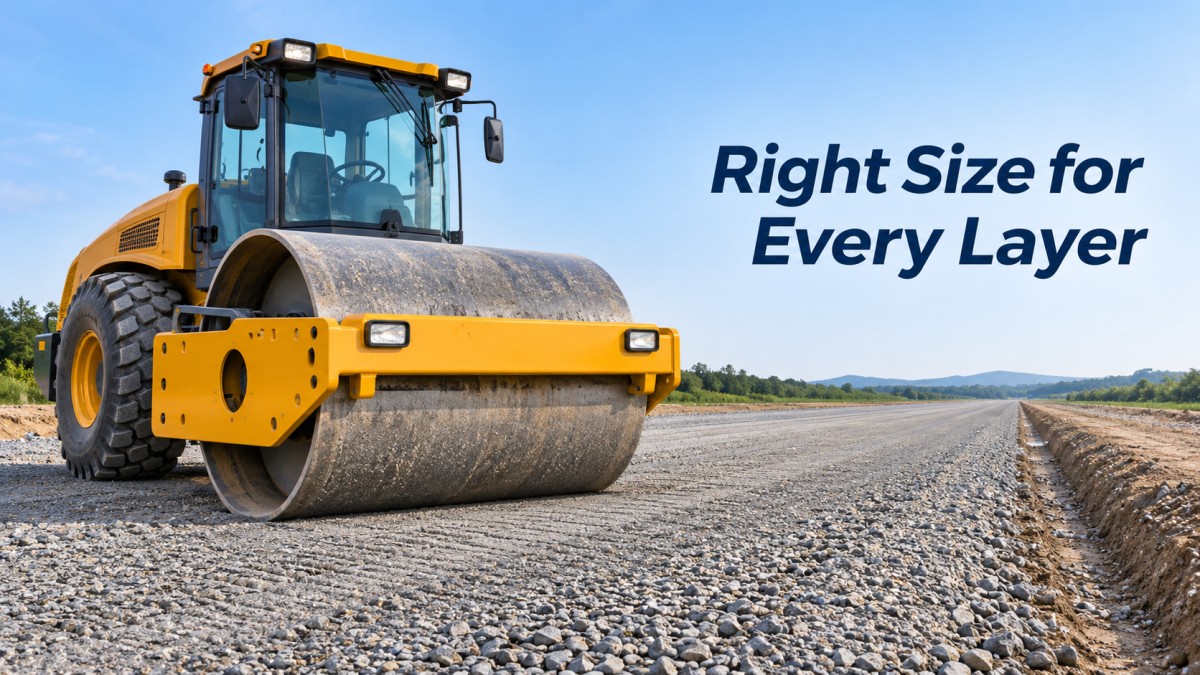
On open road base, a large single-drum vibratory roller earns its place through coverage and depth. A drum of around 2 metres, with an operating weight in the 10 to 20 tonne range, can compact a 200 to 300 mm lift of well-graded crushed stone in fewer passes than a smaller machine, provided moisture is close to optimum and the material is spread evenly. The vibration helps particles settle into a dense matrix, while the weight provides the static pressure needed to hold that density after the drum has passed. When the subgrade is weak, however, that same weight can cause rutting or pumping of fines to the surface, a sign that the layer below is not ready for a heavy roller.
Lift thickness is the constraint that most often decides the size. A roller that is too light for a thick lift will densify only the top, leaving a soft zone underneath that settles later under traffic. A roller that is too heavy for a thin lift wastes fuel and risks crushing aggregate or over-compacting a cement-treated layer. The practical check is not the brochure figure for compaction depth, but the density result through the full lift. If the bottom of the lift fails while the top passes, the machine is too small for the thickness being placed, or the lift needs to be split. Reducing lift thickness is often cheaper than bringing in a larger roller, especially when the larger machine needs low-loader transport and a wider access route.
Soil type changes the calculation. Granular soils respond well to vibration and to a smooth drum, because the particles rearrange easily when shaken. Cohesive soils, with higher clay content, need kneading action rather than vibration alone, which is why a padfoot drum is often more effective on that material. Moisture matters in both cases. Too dry, and particles do not lock together; too wet, and the soil displaces under the drum instead of densifying. A larger machine cannot correct a moisture problem, and on a wet cohesive fill it can make the surface worse by sealing the top while the material below remains soft.
Trenches reward control over force
In a trench, the working width may be 600 mm or less, with a pipe or cable at the bottom and a wall on each side. A ride-on roller cannot enter that space, and even if it could, its vibration would travel into the surrounding ground. The work therefore falls to walk-behind equipment. A vibratory plate compactor suits granular backfill around the sides of a pipe, where its flat base can work close to the structure without point loading. A rammer, with its narrow foot and high-impact action, suits cohesive backfill and very confined spots, because it drives energy downwards rather than spreading it sideways.
The risk in trench work is not under-compaction alone. Over-compaction near a pipe can deform it, crack a joint, or displace bedding material from beneath the pipe. That is why lift thickness in a trench is usually kept to 100 to 150 mm, and why the first lift over a pipe is often placed and compacted by hand or with light equipment. The compactor that works fastest on open ground becomes a liability here, not because it lacks power, but because its force cannot be directed precisely enough. A smaller machine that needs more passes is the safer choice when the cost of damaging the installed service is higher than the cost of extra labour.
Between those two extremes sit the machines used for shoulders, footpaths, car parks, and utility reinstatements. A tandem roller of 2 to 4 tonnes, a reversible plate, or a remote-controlled trench roller can cover a wider area than a walk-behind plate while still turning in a restricted space. A trench roller, in particular, fits work where an operator cannot safely stand beside the machine, such as a deep or unstable excavation. Its articulated frame and padfoot drum give it grip on cohesive material, and remote operation removes the operator from the vibration zone. It is slower than a large road roller and more expensive to hire than a plate, but it bridges the gap where neither of the other sizes is suitable.
Productivity should be judged by completed, tested area rather than by machine speed. A large roller that makes four passes over a road base and achieves density is more productive than a small plate that makes twelve passes and still leaves a soft layer. The reverse is true in a trench, where a large machine that cannot enter the cut contributes nothing, and a rammer that finishes 20 metres of backfill in a shift is the productive option. Transport, access, and turning space also affect the real rate. A roller that needs a wide turning circle will lose time at the ends of a short section, while a walk-behind machine can be lifted in and out by a small excavator or by hand.
Cost follows the same logic. Hire rate is only part of the calculation. Fuel, transport, operator time, and rework after a failed density test often exceed the difference between two sizes. A failed test means re-rolling, re-testing, and delay to the next layer, which can affect surfacing, drainage, and handover. Keeping the supporting fleet running matters here as well, since fill is usually spread by a wheel loader before compaction starts. If loader hydraulics lose efficiency, lifts become uneven and the compactor has to correct that variation pass by pass. Maintaining components such as the 4869861 SEM WHEEL LOADER VALVE [blocked] helps keep that sequence moving, rather than leaving the compactor waiting for material or working on a poorly spread lift.
A workable selection starts with four questions asked in order: how wide is the working area, how thick is each lift, what soil is being compacted, and what is already buried or built nearby. Width rules out a drum that cannot fit. Lift thickness rules out a machine that cannot reach the bottom of the layer. Soil type points to smooth drum, padfoot, plate, or rammer. Proximity to structures or services sets the limit on vibration and impact. Only after those four are answered does hire cost or availability become a deciding factor. If two sizes both pass those checks, the larger one usually wins on open ground, and the smaller one usually wins in a confined cut.
The common error is to use one size for both jobs because it is already on site. A road roller used on trench backfill risks damage and poor density at the edges. A plate used on a thick road base risks a soft layer that shows up later as settlement or cracking in the surfacing. Splitting the work between a large roller for the open base and a plate or rammer for the trench costs more in mobilisation, but it matches the force to the space. Density testing, taken through the full lift rather than only at the surface, is what confirms whether that split was the right call.
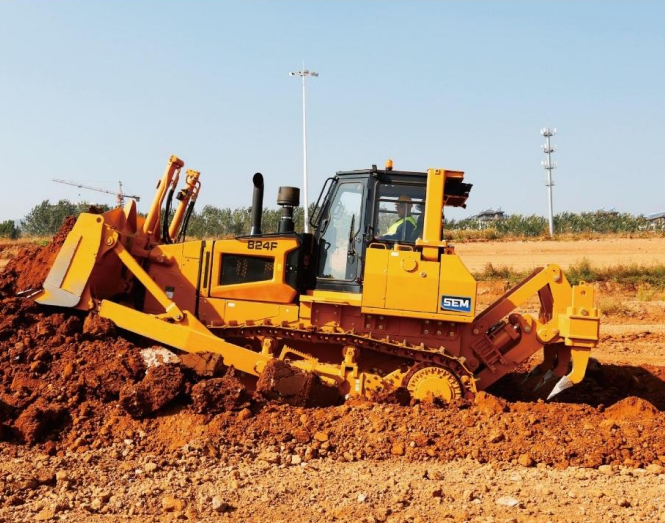
 SEM 824F ProductThe 824F features the new F Series design and is powered by a Weichai WD12T2 engine, delivering a gross power output of up to 185 kW (248 hp). The machine utilizes an electronically controlled hydrostatic transmission system, enhancing productivity and maneuverability. It offers various track shoe widths from 560 mm to 915 mm, as well as multiple blade options, including SU, S, U, Waste Handling, and Forest blades. Rear equipment options include a multi-shank ripper, single-shank ripper, and winch to meet diverse customer needs.
 SEM 920F Motor GraderThe SEM F Series Tier 2 Motor Grader is equipped with an SDEC engine and a PPC load-sensing hydraulic system for consistent, precise blade movement and reduced fuel consumption. The rear tandem drive is manufactured by Caterpillar and incorporates Caterpillar’s proven tandem axle design, delivering differentiated reliability, longer service life, and lower ownership and operating costs.
 SEM Road Roller Machines SEM 520The SEM 520 Single Drum Vibratory Road Roller is a heavy-duty compaction machine designed for large-scale road construction, highway projects and heavy earthwork tasks. Powered by a high-performance Weichai engine, it delivers steady and sufficient power for long-hour continuous operation. Equipped with the advanced pod-type sealed vibration system, it effectively resists dust and water intrusion, greatly extending the service life of core components. With powerful excitation force, optimized vibration frequency and amplitude, it achieves outstanding compaction results on soil, gravel and asphalt layers. The reinforced body structure and reliable wet brake system ensure superior stability and operational safety on various terrains. As an export-ready National II / Tier 2 model, it works well with regular fuel and features a service-friendly layout for easy daily upkeep.
 SEM Wheel Loader Machines SEM 660D 6 Ton Wheel LoaderThe SEM 660D 6 Ton Wheel Loader is a heavy-duty, high-performance machine built to tackle the most demanding loading, stockpiling, and material handling tasks. Powered by a robust 178kW Weichai engine and paired with a durable countershaft transmission, it delivers consistent power and reliable torque for its 6-ton rated load. Equipped with advanced load-sensing hydraulics, the 660D ensures smooth, responsive operation and fast cycle times, boosting productivity on every shift. With a bucket capacity ranging from 2.8 to 5.5 m³, it adapts to a wide variety of applications, including mining, quarries, ports, and construction sites. Designed with operator comfort and low maintenance in mind, this export-ready National II / Tier 2 model runs reliably on low-quality fuel and features a simple, service-friendly layout.